2024 International Women’s Day: WOFAN, Partners launch portable ambulance to promote inclusive access to Healthcare in rural farming FCT communities

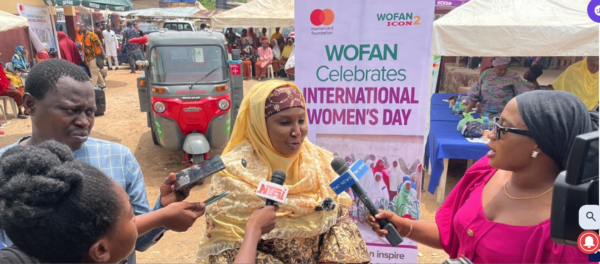
Women in Gwarimpa Village and environs in the Federal Capital Territory (FCT) could not contain their joy today as they celebrated the 2024 International Women’s Day (IWD) with the launch of an innovative portable ambulance to promote inclusive access to healthcare in underserved communities by WOFAN-ICON2 Project and some of the organization’s partners. The portable ambulance, known as Labulance is an ambulance on three wheels (tricycle) which also serves as a mobile laboratory and a clinic on wheels. The Lanbulance, which is an invention of Sonivsage, a youth led WOFAN affiliate, is expected to impact maternal mortality positively as it has facilities for supporting pregnant women during emergencies. In addition to the Labulance, a Clinic-in-a-bag concept was also presented at the IWD to the women by Benson Cole and Associates, another WOFAN partner. The Clinic-in-a-bag is a small bag which contains equipment and tools for a portable clinic which can provide mobile or on the spot primary healthcare services to families. Together, the Labulance and the Clinic-in-a-bag, are WOFAN-ICON2’s livelihood improvement intervention in Gwarimpa,aimed at improving the quality of lives of the women who are farmers and agricultural produce marketers by extendingprimary healthcare and emergency service delivery to them,their families and communities. Speaking after seeing the demonstration of the Labulance and Clinic-in-a-bag, Zeenat Lamishi, one of the women who received care at the IWD event, expressed delight with the facilities available through the Lanbulance and Clinic-in-a-bag. Hajiya Garba said the government approved the agricultural policy which gave an opportunity to WOFAN being funded by MasterCard Foundation to follow up and address the challenges of agricultural extension services. Identifying agriculture as the backbone of economic growth in any nation, Hajiya Salamatu said if the policy is translated into a bill and later to an Act, areas needed to bridge food security in Nigeria will be identified and Nigeria will be able to meet the food needs of its citizens. “This morning, I didn’t feel well but I had to come to the celebration of women’s day because, as a leader of the WOFAN-ICON2 groups, I had to see the venue and make sure everything was in place. Then, I met the staff of the Clinic-in-a-bag to complain. They took my blood, ran some tests on the spot and told me I had malaria. They gave me an injection and some drugs, and I felt well enough to join the celebration. I am very happy with the services provided from the bag”, Lamishi enthused. “And when I saw how the Labulance worked, I became even happier. With bag and the Labulance, I am confident that no child will die from malaria and no woman will die during childbirth again in our community. This is the best women’s day for us, and we are very grateful to WOFAN, all their partners and the Mastercard Foundation for bringing so much improvement to our lives in Gwarimpa.” Speaking earlier, the Country Program Director of the WOFAN-ICON2 Project and Founder of the Women Farmers Advancement Network (WOFAN), Hajia Salamatu Garba explained that the Clinic-in-a-bag and Labulance are part of the WOFAN-ICON2 Project’s community growth initiative which is aimed at not just touching the lives of project participants but also making an impact on the whole community. She said, “This initiative is not just for ICON2 participants, it is available to all members of the community. So, everyone in the community will be part of this as they will all benefit and enjoy improved access to primary healthcare and emergency services.” Hajia Salamatu further explained that all participants will make a monthly contribution of N1,000.00 to make the portable primary healthcare extension services sustainable. With this fee, she explained, participants will have access to basic primary healthcare, including basic drugs. “However, with N2,500.00 monthly contribution, a whole family can have access to the services. This ensures that families have access to primary healthcare, and it will insulate them from the current high cost of medical care in the country. And, as we all know, with good health, productivity will increase, income will be enhanced and livelihoods will be lifted”, she said.


Salamatu-WOFAN: One Woman’s Ferocious Fight Against Family Hunger And Poverty In Nigeria – By Prof. MK Othman

Nigeria, as a developing country, has a pocket of rotten eggs but is endowed with kindhearted people who give a helping hand to people in need. Hajia Salamatu Garba is a benevolent personality who founded the Women Farmers Advancement Network (WOFAN) to provide hope to the hopeless. The story of WOFAN creation is a heartwarming and motivational tale of how an act of kindness from one person can spark a lifetime dedication to helping the unfortunate and rescuing those in need. One bright sunny day, Hajia and her students of Biological Sciences at Ahmadu Bello University waited for the driver of the Departmental vehicle to go for field practicals in nearby villages. The driver failed to show up; Hajia, a tenacious woman, hardly accepted failure and thus decided to drive the students in her car for the practical. Her decision to drive the vehicle became an entry point that completely changed her life from a university lecturer to a dogged fighter against family hunger and poverty. While Hajia was driving through a village, she saw a pregnant woman carrying a heavy load on her head and holding a toddler’s hand, obviously coming from farm work to her house for another cycle of toil, cooking, washing, etc at home front. Despite the poverty surrounding the young mother’s family, she was delighted with her friendship with Hajia. Out of ecstasy, the village woman pledged to name her unborn baby Salamatu—a namesake to her new friend, an action symbolizing high cultural respect and regard for her new friend and mentor, Hajia Salamatu. After some months, Hajia visited her friend-mentee to see the new baby but was shocked to find that the lady had died during childbirth. Hajia was devastatingly sad because of the surrounding challenges of the poverty-ridden pregnant woman – malnutrition, illiteracy, poor access to healthcare, quality food, and other necessities of life, which significantly contributed to her premature death. The shock of the lady’s death changed Hajia’s pity on the women’s burdens—poverty, societal disadvantage, weak to her lifelong resolve to fight hunger ferociously and poverty bedeviling women – family, a kind of social justice crusade. The incidence of driver’s failure to show up became a blessing to hundreds of thousands of Nigerian women and youth who continue to benefit from Hajia’s struggle against the twin evils of hunger and poverty. Being an intelligent woman, Haji Salamatu is aware that resolution is a mere statement, but backing the resolution with action requires an in-depth intellectual propensity in a world full of injustice. She set up a platform for championing her resolution, the Women Farmers Advancement Network (WOFAN). Initially, Hajia Salamatu made the mistake of thinking that women could do it all alone, so WOFAN was originally a gender-biased, 100% women-dominated organization. Hajia’s odyssey started with overwhelming challenges from the male-dominated society in the north, which overshadowed her objectives of relieving women’s burdens due to gender-related imbalance. She was seen as someone trying to change the orientation of women from being submissive homemakers and mothers to aggressive partners with equal rights and freedom. Her crusade coincided with the period when the apostles of women’s liberation under the auspices of “Women in Nigeria (WIN)” advocated women’s freedom and equality. Members of WIN were seen dressing in shorts and tee shirts matching on the streets as a symbol of equality with men, a kind of abominable act in the north. So, Hajia’s struggle was mistaken for the WIN agitation. However, after four years of Hajia’s persistent struggle focusing on women’s empowerment against hunger and the dying of WIN agitation, society started accepting Hajia’s mission. Still, women’s mobilization from house to house became strenuous and daunting, with discouraging results. A woman cannot be separated from her family; while a man is the ceremonial head of the family, a woman is the backbone and pillar on which the family is built. Women are synonymous with family. Hajia Salamatu returned to the drawing board with a better strategy: rebirthing WOFAN from 100% women to 80% and 20% men, focusing on youth from 18 to 35 years of age. This formula becomes a magic wand for achieving her lifelong resolve of hunger removal and poverty alleviation. It has now been three decades since the ferocious fight was launched. What are the successes and challenges of Hajia Salamatu’s fight against family hunger and poverty? Of course, success examples abound, including young and not-so-young women and men whose lives have been positively touched by WOFAN interventions. Of course, success stories abound in the form of young and not-so-young women and men whose lives have been positively impacted by WOFAN interventions over the years. Many tell stories of enhanced income due to improved production and processing capacities because of the training provided by WOFAN and support for their groups to start small enterprises for sustainable growth, slowly but surely helping them beat the excruciating poverty that has been their lot for many years. As a result of Hajia’s passion and resolution, these women and men are becoming major contributors to their local economy, and they are now consulted when significant decisions are to be taken in the community. Hajia envisages challenges and often sets out mitigation strategies to manage them. The most exciting part is that she confronts challenges with the same energy she pursues her passion. For instance, she believes that a poor extension service delivery system is a significant challenge for food production in the country. Today, she is at the forefront of substantial stakeholders pushing for national legislation for efficient extension service delivery to improve food sufficiency. And she is confronting this challenge with uncommon ferocity! Hajia mobilized members of the National Assembly, members of federal and state executive councils, and prominent stakeholders relying on legislating the Agricultural Extension Revitalization Bill. The Federal Ministry of Agriculture and Rural Development took eight years to develop the extension policy. However, it is taking Hajia less than three months to push for legislating some aspects of the policy to enable its…